EtG testing gets described as both "infallible" and "unreliable" depending on who's talking. Neither is accurate. It's a highly sensitive, well-validated test with specific and documented limitations. Understanding both sides matters whether you're subject to the test or trying to understand a result.
What EtG Testing Does Well
Sensitivity to recent drinking. EtG is an exceptionally sensitive biomarker for alcohol consumption. At 100 ng/mL, it can detect drinking events that occurred 2-3 days earlier. No other common urine test comes close to this detection window. Breathalyzers detect intoxication within hours; urine ethanol clears within 12 hours; EtG catches events up to 80 hours later.
Specificity for alcohol metabolism. EtG is a direct metabolite of ethanol. It forms only when your liver processes ethanol. You can't test positive from an unrelated substance - there's no cross-reactivity with common medications the way there is with some immunoassay drug tests (where dextromethorphan can trigger false positives for PCP, for example). If EtG is present at meaningful concentrations (say, 500+ ng/mL), someone consumed ethanol. The question is the source, not the chemistry.
Reproducibility in certified labs. Accredited laboratories using liquid chromatography-tandem mass spectrometry (LC-MS/MS) for EtG testing produce highly consistent results. When the same specimen is run multiple times in a well-run lab, the results are essentially identical. The test itself is technically sound.
Where It Has Documented Limitations
False Positives From Incidental Exposure
This is the most clinically significant limitation, especially at 100 ng/mL. Products that contain ethanol - mouthwash, some medications, fermented foods, hand sanitizer in very high occupational exposure - can generate EtG without alcohol beverage consumption.
The concentrations from incidental exposure are typically modest (50-250 ng/mL), but they can cross a 100 ng/mL threshold. Programs that use EtG at 100 ng/mL without any evaluation protocol for incidental exposure can generate compliance consequences from genuinely non-drinking behavior.
Well-run programs address this with three tools: EtG/EtS ratio analysis (drinking elevates both; incidental exposure often elevates EtG more selectively), specimen creatinine measurement (to assess dilution), and clinical interview when results are borderline.
Concentration Doesn't Tell You Exactly How Much Was Consumed
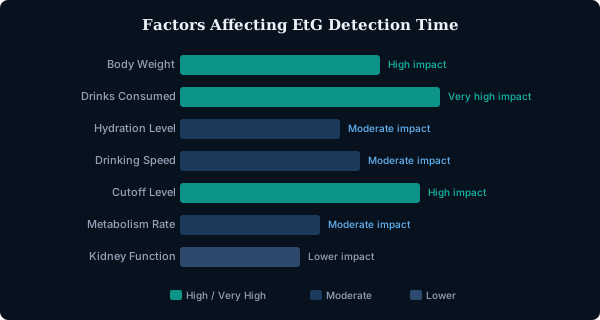
A result of 1,500 ng/mL tells you someone drank - it doesn't precisely tell you how much. The relationship between consumption and urine EtG concentration is influenced by body weight, drinking speed, hydration, and individual metabolism. Two people drinking the same amount can produce urine EtG concentrations that differ by 40-60%.
For compliance purposes, what matters is above or below the threshold - not the specific number. But in forensic and legal contexts where quantity determination matters, EtG concentration provides ranges rather than precise figures.
Individual Metabolic Variation
Glucuronidation activity - the metabolic process that creates EtG - varies between individuals. People with unusually high UDP-glucuronosyltransferase activity may process EtG faster than published averages. People with impaired liver function (cirrhosis, hepatitis, genetic enzyme variants) may process it more slowly.
This variation is genuinely substantial - studies document 20-40% inter-individual differences in EtG elimination that can't be explained by body weight, hydration, or drinking behavior. An EtG detection calculator gives you a population-average estimate; it can't tell you where you fall on the individual variation spectrum.
Stability in Stored Specimens
EtG is relatively stable in urine at room temperature for a few hours, but degrades in specimens stored incorrectly or too long. Improper specimen handling - insufficient preservative, elevated storage temperature, prolonged delay before analysis - can reduce EtG concentration. This is more of a quality control issue than a fundamental limitation of the test, but chain-of-custody procedures matter.
Some published case reports describe EtG appearing in urine specimens after storage - apparently from microbial fermentation of glucose in urine specimens that were contaminated. This is rare and prevented by proper specimen handling, but it's worth knowing that laboratory procedures affect result validity.
What EtG Testing Cannot Tell You
It can't tell you the source of the ethanol. A positive EtG result means someone consumed ethanol. It doesn't tell you whether that was from a beverage, a medication, or a food product. This is why clinical context and program-specific evaluation protocols matter.
It can't distinguish sobriety from drinking timing. A positive EtG result means someone drank within the detection window - it doesn't mean they're currently impaired or were intoxicated. This seems obvious but matters in legal and employment contexts where "under the influence" and "tested positive for recent alcohol use" are different things.
It can't tell you anything about current impairment. EtG is not a test for intoxication. A person can test EtG-positive and be completely sober. This is the whole point of the test - detecting past drinking - but it's sometimes misrepresented in non-medical contexts.
It can't reliably quantify heavy consumption beyond a range. Peak concentrations in heavy drinking scenarios vary enough between individuals that precise drink counts from a urine EtG number aren't possible. You can say "this result is consistent with significant alcohol consumption" but not "this person had exactly 7 drinks."
Understanding Your Result in Context
If you received a positive result and believe it came from incidental exposure rather than drinking, several things help your case: documented use of specific products, a result concentration in the range consistent with incidental exposure (typically below 300 ng/mL), and absence of other clinical signs of alcohol use.
If you used the EtG urine test calculator to estimate your detection window and the result doesn't match, consider the individual variation factor: the model shows the statistical average. Your actual elimination rate may be faster or slower.
For a detailed look at what can cause false positives, see our guide on EtG false positive sources. For a plain-language breakdown of detection windows, the complete EtG detection timeline covers the full range of scenarios.
*Sources: Jatlow P & O'Malley SS, Alcoholism: Clinical and Experimental Research, 2010; SAMHSA Mandatory Guidelines for Federal Workplace Drug Testing.*