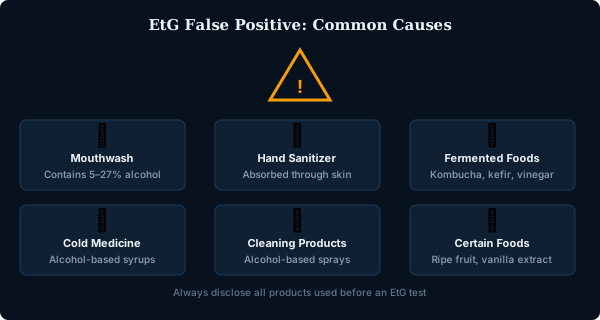
If you've never had a drink and still got a positive EtG result, you're not imagining it. Incidental ethanol exposure from everyday products is a real, documented phenomenon - and it's the source of genuine false positives in EtG urine testing.
The key word is "incidental." Small amounts of ethanol from non-beverage sources can produce EtG in urine. Whether that's enough to trigger a positive depends entirely on the test cutoff level and how much of the product you used.
How It Happens
EtG forms whenever your liver processes ethanol - regardless of the source. Your body doesn't distinguish between ethanol from a glass of wine and ethanol absorbed from a mouthwash gargle. Any absorbed ethanol gets metabolized, and a small fraction becomes EtG.
The question is whether the resulting EtG concentration in urine reaches the test threshold. At 500 ng/mL, most incidental exposures don't come close. At 100 ng/mL, the margin is much thinner, and documented false positives become more common.
Mouthwash - The Most Documented Source
Alcohol-containing mouthwash is the most studied source of EtG false positives. Standard antiseptic mouthwashes like original Listerine contain 21-26% ethanol. Gargling with 20 mL of this product and spitting delivers some absorbed ethanol through the oral mucosa.
Published studies have found urine EtG levels of 50-170 ng/mL after standard mouthwash use. At a 500 ng/mL cutoff, this typically won't register as positive. At 100 ng/mL, it can - particularly if someone gargled multiple times or swallowed any.
Practical implication: In any 100 ng/mL monitoring program, switch to an alcohol-free mouthwash (brands like ACT, TheraBreath, and most generic pharmacy brands offer alcohol-free versions). This eliminates the exposure entirely.
Hand Sanitizer - Absorbed Through Skin or Inhalation?
Hand sanitizer contains 60-70% ethanol. The absorption question gets more nuanced here. Research generally shows that normal topical use produces only minimal systemic ethanol absorption - not enough to generate meaningful EtG.
However, there are documented exceptions:
For most people, hand sanitizer isn't a realistic false positive risk at 500 ng/mL. At 100 ng/mL, healthcare workers and others with very high occupational exposure should mention this to their monitoring program and, if possible, switch to non-alcohol-based hand sanitizers during monitoring periods.
Fermented Foods and Beverages
Non-alcoholic beer, kombucha, ripe fruit, and some vinegars contain small amounts of ethanol from natural fermentation. "Non-alcoholic" beer typically contains 0.5% ABV or less. Kombucha can range from trace amounts to 3%+ in home-brewed batches.
Published research has found low-level EtG (typically under 100 ng/mL) after consuming large amounts of non-alcoholic beer or kombucha. One study found EtG levels up to 220 ng/mL in participants who drank multiple liters of non-alcoholic beer. That's below 500 ng/mL but above 100 ng/mL.
Practical guidance for monitoring programs: Avoid kombucha, non-alcoholic beer, and large amounts of fermented vinegar products while subject to 100 ng/mL testing. The ethanol content is low enough that most people won't trigger a positive with normal consumption, but it's not zero risk.
Medications and Other Products
Several medications and topical products contain ethanol in amounts large enough to raise EtG at 100 ng/mL:
Cough syrups and liquid medications: Many liquid formulations use ethanol as a solvent. Some cough medicines contain 10-25% ethanol. Taking a full dose can produce absorbed ethanol equivalent to a fraction of a standard drink.
Topical medications: Some creams and transdermal patches use ethanol as a carrier. Systemic absorption is generally minimal, but very large-area applications (like large wound dressings or extensive topical treatments) can result in detectable absorption.
Vanilla extract: Pure vanilla extract is 35% ethanol. If you're baking and taste-testing frequently, you could consume meaningful amounts. This is mostly relevant for cooking scenarios, not typical daily exposure.
What Levels These Products Actually Produce
To put this in perspective, research data on incidental EtG exposure typically shows:
| Source | Typical EtG Result | Risk at 500 ng/mL | Risk at 100 ng/mL |
|---|---|---|---|
| Alcohol mouthwash (normal use) | 50-170 ng/mL | Very low | Possible |
| Non-alcoholic beer (1-2 cans) | 30-90 ng/mL | Very low | Low |
| Non-alcoholic beer (5+ cans) | 80-220 ng/mL | Low | Moderate |
| Hand sanitizer (normal topical) | <20 ng/mL | Negligible | Very low |
| Liquid cough medicine (full dose) | 20-100 ng/mL | Very low | Possible |
These are ranges from published studies - individual results vary. A positive from a non-beverage source is typically in the 100-300 ng/mL range, which is well below the concentrations that result from actual drinking (often 1,000+ ng/mL for a few drinks).
How Programs Handle Claimed False Positives
If you receive a positive EtG result you believe came from incidental exposure, the process typically works like this:
Protecting Yourself
The safest approach in any monitoring program: read labels. Avoid products with alcohol listed in the ingredients during the monitoring period. Switch to alcohol-free mouthwash, avoid fermented beverages beyond standard foods, and be aware of your medications' ethanol content.
If you're uncertain whether your EtG level came from drinking or something else, our EtG calculator can help you calibrate - if you drank a specific amount, run those inputs and see whether the resulting estimate matches the test result. A 115 ng/mL result from claimed zero drinking doesn't look like what the model produces for even 1 drink (typically 400-600 ng/mL peak).
For more on the accuracy and limitations of EtG testing generally, see our article on EtG test accuracy and what it can't tell you.