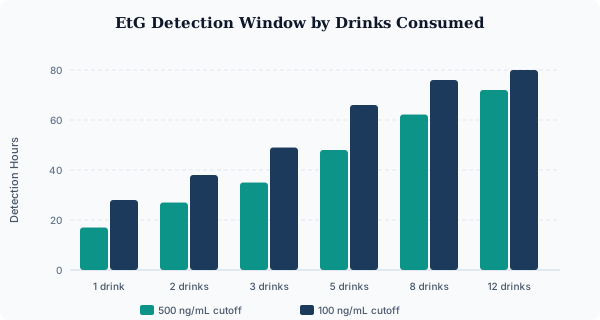
EtG (Ethyl Glucuronide) is the reason a urine test can come back positive two days after your last drink - even when your blood alcohol has been zero for 30+ hours. Understanding how long it actually stays in your system requires getting past the vague "up to 80 hours" claim that gets thrown around.
The real answer depends on how much you drank, the test cutoff level, your body weight, and your individual metabolism. Let's break it down.
What Is EtG and Why Does It Persist?
Your liver processes about 90% of the ethanol you consume by converting it to acetaldehyde, then to acetate, which your body burns as fuel. But a small fraction - roughly 0.01-0.06% of total ethanol - goes through a different pathway. Enzymes called UDP-glucuronosyltransferases conjugate it with glucuronic acid to produce Ethyl Glucuronide.
EtG isn't alcohol. It doesn't impair you. But it's a direct metabolic product of alcohol, and your kidneys filter it into urine, where it remains measurable for far longer than ethanol itself. That's why courts, probation programs, and employers use EtG testing - it catches drinking events that happened well before the test.
Detection Windows by Drink Count
The most important variable is how much you drank. Here are typical detection windows at the 500 ng/mL cutoff (the standard for most workplace and clinical tests):
| Drinks Consumed | Approximate Detection Window |
|---|---|
| 1 standard drink | 12-24 hours |
| 2 drinks | 18-32 hours |
| 3 drinks | 24-40 hours |
| 5 drinks | 32-52 hours |
| 8 drinks | 48-68 hours |
| 12+ drinks | 60-80 hours |
These are averages based on pharmacokinetic research. Your actual window could be shorter or longer by 20-30% depending on your body weight, how fast you drank, and your individual glucuronidation enzyme activity.
You can enter your specific details into our EtG detection time calculator to get a personalized estimate based on the research model.
How the 100 ng/mL Cutoff Changes Everything
The numbers above apply to 500 ng/mL tests. At 100 ng/mL - the strict cutoff used in probation, drug courts, and many alcohol treatment monitoring programs - the windows extend considerably.
A trace amount of EtG that falls below 500 ng/mL may still be well above 100 ng/mL. The same 5-drink session that clears at the 500 ng/mL threshold within 48 hours might remain detectable at 100 ng/mL for 60-70 hours. Heavy drinking (8+ drinks) can push 100 ng/mL detection to 72-80 hours routinely.
If you're subject to a 100 ng/mL program - and many probation and sobriety monitoring programs are - assume your detection window is 30-50% longer than the standard figures suggest. Use the etg urine test calculator with the 100 ng/mL option selected to model your specific scenario.
Why Individual Results Vary
The published data gives us averages. Here's what moves your result up or down:
Body weight. EtG concentration in urine is partly a function of body size. A 140 lb person and a 220 lb person who drink the same amount will have different peak EtG concentrations - the heavier person's larger blood volume dilutes the metabolite, generally shortening the detection window somewhat.
Drinking speed. Four drinks in 90 minutes produces a higher EtG spike than four drinks over five hours. When you drink fast, more alcohol hits your liver at once, and the glucuronidation process generates more EtG in a shorter window.
Hydration. Drinking water doesn't flush EtG out faster, but it does dilute its concentration in urine. If your urine is very dilute (low creatinine), you may fall below the detection threshold slightly earlier. Testing programs are aware of this and may flag specimens with extremely low creatinine as suspicious.
Liver function. Glucuronidation efficiency varies between individuals based on genetics, age, and liver health. People with impaired liver function may actually process EtG more slowly, extending the window. This is the variable that calculators can't fully capture.
Metabolism generally. There's genuine inter-individual variation in alcohol metabolism that goes beyond body weight. Studies have documented EtG detection windows that vary by 20-40% between otherwise similar individuals drinking the same amount.
The 80-Hour Claim - Where Does It Come From?
You'll often see "EtG can be detected for up to 80 hours" stated without any qualification. This is technically accurate but misleading without context.
The 80-hour figure comes from heavy drinking scenarios - typically 8-12+ standard drinks - tested at the 100 ng/mL cutoff. Under those conditions, some research subjects showed positive EtG results approaching 80 hours after their last drink. The Høiseth et al. (2007) study and replication work by Wurst et al. (2003) document these outer limits.
For light or moderate drinkers at the 500 ng/mL cutoff, the window is far shorter - often 24-36 hours. Applying the 80-hour ceiling to all drinking scenarios overstates the risk significantly for most people.
Checking Your Timeline
If you need a specific estimate for your situation, the most useful thing you can do is enter your actual details - drink count, body weight, drinking duration, and cutoff level - into our EtG calculator. The tool models your specific inputs against the published pharmacokinetic data rather than giving you a generic range.
What it can't account for is individual metabolic variation. The calculation gives you a best-estimate midpoint. For compliance purposes, especially at 100 ng/mL, build in extra buffer time beyond what the calculator shows.
Key Takeaways
For more on the factors that extend or shorten your detection window, read our guide on what affects EtG detection time. And if you're facing a 100 ng/mL test, our deep dive on 100 vs 500 ng/mL cutoffs explains exactly what that means for your window.
*Source: Høiseth G, et al. Forensic Science International, 2007; Wurst FM, et al. Addiction, 2003.*