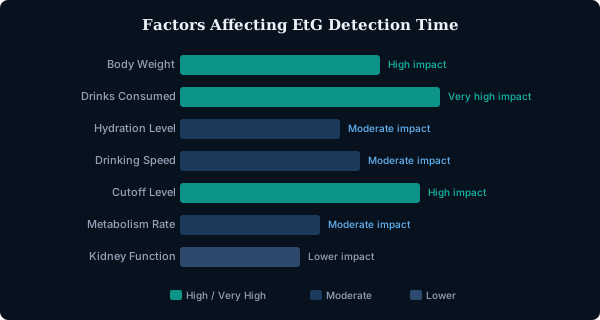
The "EtG stays in urine for up to 80 hours" headline is technically true - and almost useless on its own. That window applies to heavy drinking at the strictest cutoff level. A person who had two drinks will likely test clear in under 24 hours. The difference between those two scenarios comes down to six specific variables.
Here's how each one works and how much it actually matters.
1. Number of Drinks - The Biggest Factor
If you remember only one thing: drink count drives EtG detection time more than anything else. More alcohol consumed means more EtG produced.
The math is roughly linear: each additional standard drink adds approximately 10-15 hours to your detection window, depending on drinking speed and body weight. A person who had 2 drinks is looking at a 24-36 hour window at 500 ng/mL. Someone who had 8 drinks is looking at 50-70 hours under the same conditions.
What counts as a standard drink? One 12 oz regular beer (5% ABV), one 5 oz glass of wine (12%), or 1.5 oz of 80-proof spirits. A 7% craft IPA in a 16 oz pour counts as roughly 1.9 standard drinks. High-proof cocktails can pack 2-3 standard drinks without looking like more than one glass. Miscounting your drinks is the most common reason estimates turn out wrong.
Use the EtG calculator with your actual drink count to see how much that number shifts your window.
2. Test Cutoff Level - The Second Biggest Factor
The cutoff is the concentration threshold above which a positive result is called. Two common levels:
500 ng/mL is standard for workplace drug tests, pre-employment panels, and most clinical EtG tests. At this threshold, moderate drinking (3-5 drinks) typically clears within 36-52 hours.
100 ng/mL is used in probation, drug courts, SCRAM monitoring alternatives, and many alcohol treatment programs. This is significantly stricter. The same 3-5 drinks that clear at 500 ng/mL within 48 hours may still read positive at 100 ng/mL for 60-72 hours.
If you don't know which cutoff your program uses, 100 ng/mL is the safer assumption for any monitoring program. Our EtG urine test calculator lets you model both thresholds side by side.
3. Drinking Speed - Often Overlooked
How fast you drank matters because it determines how high your EtG peak gets.
If you had 6 drinks over 6 hours, your liver was processing alcohol gradually throughout. The peak EtG concentration in your urine was moderate. If you had those same 6 drinks in 2 hours, your liver got hit with more ethanol at once, producing a higher EtG spike and a longer detection window.
The difference isn't dramatic for most scenarios - maybe 8-15% - but it's real. In the calculator model, a 3-hour drinking duration (the default) represents a typical evening out. If your session was shorter, set the duration lower; if you drank casually over 8 hours, set it higher.
4. Body Weight - A Moderate Effect
A 130 lb person and a 240 lb person drinking the same amount will have different EtG concentrations. Body weight affects this in two ways.
First, larger people have more blood volume, which dilutes alcohol concentration during absorption. This means their peak EtG per drink is somewhat lower. Second, people with more body mass generally have higher liver mass, which affects overall processing capacity (though this relationship is less direct than you might think).
In practical terms, a 240 lb person might see their detection window run 15-20% shorter than a 130 lb person drinking the same number of drinks. That's meaningful - but it's secondary to the drink count and cutoff variables.
5. Hydration - Concentration Effect, Not Elimination
Here's a common misconception: drinking lots of water makes EtG leave your body faster. It doesn't. Water doesn't speed up glucuronidation or renal EtG clearance.
What hydration does is dilute your urine, which lowers the EtG concentration per milliliter. If your urine is very dilute, the EtG concentration may fall below the detection threshold sooner - not because it left faster, but because each mL of urine contains less of it.
At 500 ng/mL, well-hydrated urine might bring your window down by 10-20%. At 100 ng/mL, the effect is less reliable because you need EtG to fall much lower before the test reads negative.
The other thing to know: many testing programs check creatinine levels alongside EtG. Very dilute urine (creatinine under 20 mg/dL) can trigger an "invalid" or "dilute" result, requiring a retest. Excessive hydration isn't a reliable way to pass and can raise flags.
6. Individual Metabolism and Liver Function
After accounting for all the factors above, there's still variation that comes down to you specifically. UDP-glucuronosyltransferase activity - the enzyme system that produces EtG in the first place - varies between individuals based on genetics, age, and liver health.
Studies show EtG windows can vary by 20-40% between individuals who are otherwise similar in body weight, drinking amount, and hydration. This is why the calculator produces an estimate, not a guarantee. For a person with very high glucuronidation activity, EtG may clear faster than predicted. For someone with impaired liver function, it may clear more slowly.
This factor also explains why some people report testing positive (or negative) at times that don't match generic timelines. Individual variation is real and substantial.
Putting It Together
The single most useful thing you can do is run your specific numbers - drinks, body weight, drinking duration, cutoff level - through our EtG detection calculator rather than relying on generic ranges. The model accounts for the first five factors listed here. The sixth (individual metabolism) is the wild card that no tool can fully capture, which is why building in extra buffer time is always prudent when the stakes are high.
For a full breakdown of how long EtG stays detectable at different drinking levels, see our article on EtG detection timelines. And if you want to understand the difference between 100 and 500 ng/mL tests in detail, our cutoff level guide covers exactly that.
*Sources: Høiseth G, et al. Forensic Science International, 2007; Wurst FM, et al. Addiction, 2003.*