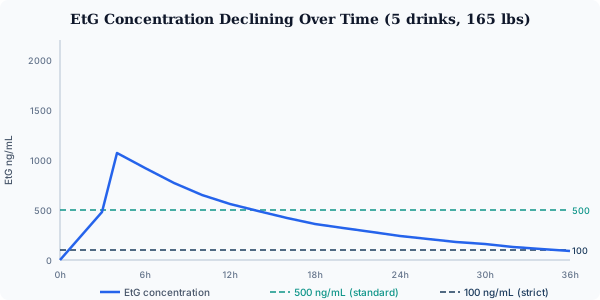
Pharmacokinetics is just a formal way of saying "what the body does to a substance over time." For EtG, the pharmacokinetics determine how quickly it appears in urine, how high the concentration gets, and how long it takes to clear. Understanding these mechanics explains why a calculator produces the estimates it does - and where the limits of those estimates lie.
What Happens When You Drink Alcohol
When you consume ethanol, it absorbs through the stomach and small intestine into the bloodstream, then travels to the liver for processing. The liver handles approximately 90% of the ethanol clearance through two main pathways:
The small fraction matters: even though glucuronidation handles a tiny percentage of ethanol, the resulting EtG is far more detectable for far longer than ethanol itself.
How Peak Urine EtG Is Determined
EtG appears in blood first (within 30-60 minutes of ethanol absorption beginning), then gets filtered into urine. The peak EtG concentration in urine typically occurs 3-5 hours after the last drink - later than blood EtG peaks because urine accumulates in the bladder over time.
The key research benchmark comes from Høiseth G et al. (Forensic Science International, 2007): peak urine EtG concentrations of approximately 350-450 ng/mL per standard drink at a 70 kg (154 lb) reference body weight. This study involved controlled alcohol administration to human subjects with sequential urine collection - direct measurement, not modeling.
For a 70 kg person who drank 5 standard drinks, expected peak EtG would be roughly 1,750-2,250 ng/mL. Body weight adjusts this proportionally - a 50 kg person would have a higher peak per drink (less volume to dilute the metabolite); a 100 kg person would have a lower peak.
The Half-Life: How Fast EtG Clears
EtG elimination from urine follows first-order kinetics - a consistent fraction clears per unit time, regardless of the starting concentration. Think of it like exponential decay: each hour, the concentration decreases by a fixed percentage.
The urine EtG half-life is approximately 2.5-3.5 hours in the published literature. Wurst FM et al. (Addiction, 2003) documented values in this range across their study population. Subsequent research has replicated this window.
Our calculator uses 3.0 hours as the midpoint estimate. At this half-life:
Getting from a 2,000 ng/mL peak to below 500 ng/mL requires about 2 half-lives = 6 hours of elimination. Getting to below 100 ng/mL requires nearly 4.5 half-lives = 13.5 hours.
This is why the 100 vs 500 ng/mL cutoff makes such a large difference in detection windows - it's the same elimination rate, but a much lower threshold to cross.
The Detection Window Calculation
Combining the peak EtG model with the half-life gives us the detection window formula:
Detection hours = Time to peak + [(ln(Peak EtG ÷ Cutoff) ÷ ln(2)) × Half-life]
Where:
Example: 165 lb (75 kg) person, 4 drinks, 500 ng/mL cutoff.
Peak EtG = 4 × 400 × (70 ÷ 75) = 1,493 ng/mL
Detection time = 1.5 + [(ln(1493 ÷ 500) ÷ 0.693) × 3.0]
= 1.5 + [(1.099 ÷ 0.693) × 3.0]
= 1.5 + [1.586 × 3.0]
= 1.5 + 4.76
= 6.26 hours from last drink
That's about 6-7 hours total - so if drinking ended at 11 PM, a 500 ng/mL test might read positive until around 5-6 AM, or later with individual variation. Our EtG calculator runs this calculation for your specific inputs and rounds to the nearest hour.
Why Individual Results Vary
The pharmacokinetic model describes population averages. Real individuals deviate for several reasons:
UGT enzyme variation. The UGT enzymes that produce EtG have known genetic variants affecting activity levels. People with high-activity variants produce more EtG per drink and may retain it longer. People with low-activity variants produce less.
Renal clearance rate. EtG gets filtered by the kidneys. Kidney function affects elimination rate - people with impaired renal function may clear EtG more slowly.
Hydration and urine output. High urine volume dilutes EtG concentration without eliminating it faster. This affects the ng/mL concentration in any given sample, which can move results relative to the threshold, even if total EtG excretion is unchanged.
Hepatic function. The liver produces EtG. Liver disease can impair glucuronidation, potentially changing both peak production and elimination.
Published studies document inter-individual variation of 20-40% in EtG excretion among people who drink similar amounts under similar conditions. This variation represents the primary limitation of any pharmacokinetic estimate - including calculator outputs.
What This Means for Estimates
When you use the EtG detection time calculator, you're getting the expected value from a population-average model - not a guarantee for your specific metabolism. The estimate is calibrated against published human data, so it's a scientifically grounded starting point. But the 20-40% variation means your actual window could be shorter (if you're a fast metabolizer) or longer (if you're slower than average).
For compliance purposes, treating the estimate as a minimum and adding buffer time is the prudent approach. The pharmacokinetics tell you where the average is; your individual biology determines where you actually land.
For a plain-language timeline of how these pharmacokinetics translate into detection windows by drinking amount, see our guide on how long EtG stays in urine. For the accuracy and limitations side, see what EtG testing can and cannot tell you.
*Sources: Høiseth G, et al. Forensic Science International, 2007; Wurst FM, et al. Addiction, 2003; Jatlow P, O'Malley SS, Alcoholism: Clinical and Experimental Research, 2010.*