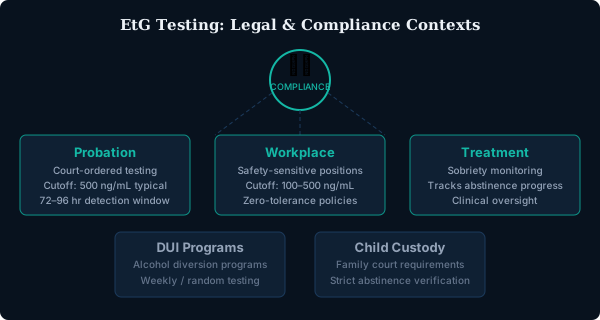
If alcohol is a condition of your probation, parole, or drug court program, EtG urine testing is almost certainly part of it. Standard drug panels don't test for alcohol - EtG testing was developed specifically to extend alcohol detection beyond the 6-12 hour window that urine alcohol provides.
Here's what you're actually dealing with, how the testing works, and what matters most for compliance.
Why Probation Programs Use EtG Testing
Breathalyzers and urine alcohol tests only detect ethanol itself. Ethanol clears from urine within 6-12 hours of stopping drinking. Someone tested Monday morning could have drank heavily Saturday night without any standard test catching it.
EtG changes that. Because it's a metabolite rather than alcohol itself, it persists in urine for 24-80 hours after drinking ends. A Monday test can catch a Saturday night event. A Wednesday test can potentially catch a Monday drinking episode at low cutoffs.
For supervision programs that require alcohol abstinence, this extended window makes EtG practically essential. Two or three tests per week with EtG coverage creates near-continuous monitoring for the period between tests.
What Cutoff Level Does Your Program Use?
The most important thing to know: what cutoff level has your program set?
Most probation and drug court programs that require alcohol abstinence use 100 ng/mL - the strict cutoff. This extends your detection window by roughly 30-50% compared to the 500 ng/mL standard. A drinking event that might clear a standard workplace test by Monday morning may still show on a 100 ng/mL test Monday afternoon.
A smaller number of programs use 500 ng/mL, which provides meaningful detection but with shorter windows. Pre-employment and workplace tests almost always use 500 ng/mL.
If you don't know your program's cutoff: assume 100 ng/mL. It's the more conservative assumption and it protects you. Your probation order, program intake paperwork, or the testing facility can confirm the specific threshold.
Detection Windows in a Monitoring Context
At 100 ng/mL, here are approximate detection windows by drinking scenario (165 lb person, normal hydration):
These are model-based estimates. Individual variation means some people will clear faster, others slower. For compliance purposes, treat these as minimum timelines and add buffer.
You can run your specific scenario - your weight, drink count, drinking duration - through our EtG calculator to get a personalized estimate. Select 100 ng/mL as the cutoff if your program uses strict monitoring.
How Testing Schedules Work With Detection Windows
Most probation and drug court programs test 1-3 times per week. At 100 ng/mL, with testing twice per week, the gap between tests is typically 2-4 days. Even moderate drinking (3-4 drinks) can remain detectable across a 2-day gap at 100 ng/mL.
Some programs use random testing specifically because it removes predictability. You can't work backwards from a scheduled test date when you don't know when the test will happen.
SCRAM (Secure Continuous Remote Alcohol Monitor) bracelets are used alongside or instead of urine testing in some programs - these detect alcohol vapor through the skin and provide near-real-time monitoring. If you're also wearing a SCRAM bracelet, understand that it and EtG tests catch different things (real-time transdermal alcohol vs. historical urine EtG).
What Happens When You Get a Positive
A positive EtG result in a monitoring program triggers a review process, not necessarily immediate consequences. Depending on your jurisdiction and program:
A result of 120 ng/mL with a documented explanation (alcohol-containing mouthwash, for example) is treated very differently than a result of 2,800 ng/mL. Courts have seen both scenarios.
Non-Drinking Sources That Can Trigger Positive Results
At 100 ng/mL, everyday products containing ethanol can occasionally produce low-level positive results. The most common sources:
Alcohol-containing mouthwash - Products like original Listerine contain 21-26% ethanol. Gargling can produce urine EtG of 50-170 ng/mL in some users. Switch to alcohol-free mouthwash (ACT, TheraBreath, or any pharmacy brand labeled "alcohol-free").
Kombucha and non-alcoholic beer - These contain small amounts of ethanol from fermentation. Large amounts can produce EtG at 100-200 ng/mL. Avoid during monitoring.
Liquid medications - Some cough syrups and liquid medications contain ethanol as a solvent. Check labels for "alcohol" in the inactive ingredients.
For a detailed breakdown of each source, see our guide on EtG false positives and what can cause them.
Practical Guidance for Staying Compliant
Read labels. Switch to alcohol-free versions of any product you use regularly - mouthwash, some topical medications, certain food products.
Don't use the "incidental exposure" defense preemptively. If you drank alcohol, document it. Claiming incidental exposure when the result is actually from drinking tends to make compliance situations worse, not better.
Use the calculator to understand your timeline, not to game it. This tool is built on research data and gives reasonable estimates - but it can't account for your individual metabolic variation. At 100 ng/mL, the safest approach is to abstain entirely. No amount of estimate-checking changes the biology.
Communicate with your program. If you have a legitimate medical reason for a result (a hospitalization, a medication containing alcohol), communicate that to your PO or case manager proactively.
Know your testing schedule. If you're tested twice a week and you're unsure whether a weekend event will clear, our EtG detection calculator gives you a data-informed estimate. But add buffer - the model shows you the expected average, and individual variation can push that later.
The Bigger Picture
EtG testing in probation and court programs is specifically designed to be harder to circumvent than standard alcohol testing. It was developed because the 6-12 hour ethanol window left too many gaps in supervision. Understanding how it works - the detection windows, the cutoff levels, the factors that affect results - is the foundation for making informed decisions during the monitoring period.
For questions about how cutoff levels affect detection windows specifically, read our article on 100 vs 500 ng/mL EtG cutoff differences.