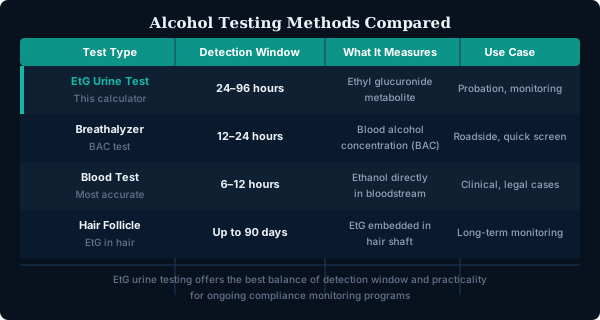
Different alcohol tests catch different things. A breathalyzer tells you if someone is currently impaired. A blood alcohol test is the gold standard for acute intoxication. An EtG urine test tells you if someone drank alcohol in the past 24-80 hours, regardless of current impairment.
These aren't competing tests - they measure different things and serve different purposes. Understanding what each actually detects helps you understand why courts, employers, and monitoring programs choose specific tests for specific situations.
Breathalyzer (Breath Ethanol Testing)
What it measures: Ethanol vapor exhaled from the lungs. The concentration correlates to blood alcohol content (BAC) through a partition ratio.
Detection window: Only as long as ethanol remains in your bloodstream. Most people metabolize alcohol at roughly 0.015% BAC per hour. Someone who reached a peak BAC of 0.10% would test negative approximately 6-7 hours later.
Detection limit: 0.02-0.04% BAC is the typical threshold for positive results, depending on the device and jurisdiction.
Use cases: Traffic stops, sobriety checkpoints, ignition interlock devices, workplace safety checks, any situation requiring detection of current or very recent impairment.
Limitations: Zero retrospective detection. If someone drank 8 hours ago and metabolized to zero BAC, a breathalyzer reads negative. It tells you nothing about drinking that occurred before the metabolism window.
Blood Alcohol Test (BAC)
What it measures: Ethanol concentration in blood, expressed as % weight/volume (0.08% = 0.08 grams of alcohol per 100 mL of blood).
Detection window: Similar to breath - only as long as ethanol persists. At 0.015%/hour metabolism, a 0.08% BAC clears in about 5 hours. A 0.18% BAC (heavily intoxicated) clears in about 12 hours.
Accuracy: Considered the forensic gold standard for current intoxication. More accurate than breathalyzers and less susceptible to breathing pattern artifacts.
Use cases: Post-accident investigations, DUI prosecutions, emergency medicine, any situation requiring legally defensible evidence of intoxication level.
Limitations: Invasive (requires blood draw). Like breathalyzers, provides no retrospective detection. If blood is drawn after alcohol has been metabolized, BAC reads zero regardless of recent drinking history.
Urine Ethanol Test
What it measures: Ethanol in urine. Urine alcohol lags behind blood alcohol by 30-60 minutes (bladder holds the previous sample).
Detection window: Roughly 8-14 hours after stopping drinking, somewhat longer than blood because urine takes time to accumulate.
Use cases: Quick point-of-care screens when BAC testing isn't available. Less accurate than blood; sometimes used in emergency medicine for rapid assessment.
Limitations: Short detection window, lags behind blood alcohol, prone to dilution. Largely replaced by EtG testing for monitoring purposes because of the limited window.
EtG Urine Testing (Ethyl Glucuronide)
What it measures: EtG, a direct metabolite of ethanol produced by the liver. Not ethanol itself - the aftermath of ethanol processing.
Detection window: 24-80 hours depending on the amount consumed and the test cutoff. At 500 ng/mL: moderate drinking (3-5 drinks) detectable for 36-52 hours. At 100 ng/mL: 48-72 hours for the same consumption. Use the EtG calculator to estimate your specific window.
Use cases: Sobriety monitoring programs (probation, drug courts, alcohol treatment), retrospective investigation of drinking in post-incident testing, workplace programs requiring alcohol abstinence beyond standard drug panel testing.
Limitations: Does not indicate current impairment. Cannot distinguish drinking from incidental ethanol exposure at low concentrations. Cannot reliably quantify exactly how much was consumed.
EtS (Ethyl Sulfate) - EtG's Partner Biomarker
Ethyl Sulfate is another direct alcohol metabolite, produced through sulfation rather than glucuronidation. EtS has a very similar detection window to EtG (slightly shorter in some studies), and the two are almost always measured together in professional monitoring contexts.
The EtG/EtS ratio is useful for evaluating suspected incidental exposure. When someone drinks alcohol, both biomarkers elevate proportionally. When incidental ethanol exposure (mouthwash, for example) causes a positive result, EtG often rises without proportional EtS elevation. Programs that monitor EtG use EtS as a cross-check.
SCRAM (Transdermal Alcohol Testing)
SCRAM bracelets measure alcohol vapor evaporating through the skin (transdermal alcohol). They provide near-continuous monitoring - sampling every 30 minutes - and detect alcohol use in near-real-time.
Detection window: Transdermal alcohol lags blood alcohol by 1-2 hours and tracks it relatively closely. SCRAM detects active alcohol use as it occurs, not past drinking events.
SCRAM and EtG testing are often used together in monitoring programs - SCRAM catches ongoing drinking in real-time; EtG tests in the days between confirm continued abstinence.
Which Test Gets Used for What
| Purpose | Test Used |
|---|---|
| DUI traffic stop | Breathalyzer, blood BAC |
| Post-accident investigation | Blood BAC |
| Pre-employment drug screen | EtG urine (5-panel including alcohol) |
| Probation alcohol monitoring | EtG urine (100 ng/mL) ± SCRAM |
| Drug court compliance | EtG urine (100 ng/mL), 2-3×/week |
| Ignition interlock | Breath (BAC) |
| Workplace random testing | EtG urine (500 ng/mL) |
When EtG Is the Right Tool - and When It Isn't
EtG makes sense when the question is: "Did this person drink alcohol in the past 24-80 hours?" It's the most effective tool available for that specific question. No other test comes close to that detection window.
EtG doesn't make sense for: current impairment detection, precise quantification of consumption, or any situation where the question is "is this person currently under the influence?"
For monitoring programs where the requirement is alcohol abstinence over an extended period, EtG testing at 100 ng/mL with 2-3 tests per week provides effectively continuous surveillance of the monitoring period. That's why it's become standard in probation, drug court, and alcohol treatment compliance testing.
If you're trying to understand how long a specific drinking event will be detectable by an EtG test, our EtG detection time calculator gives you a model-based estimate based on published pharmacokinetic research.
*Sources: SAMHSA Mandatory Guidelines for Federal Workplace Drug Testing; Jatlow P, O'Malley SS, Alcoholism: Clinical and Experimental Research, 2010.*