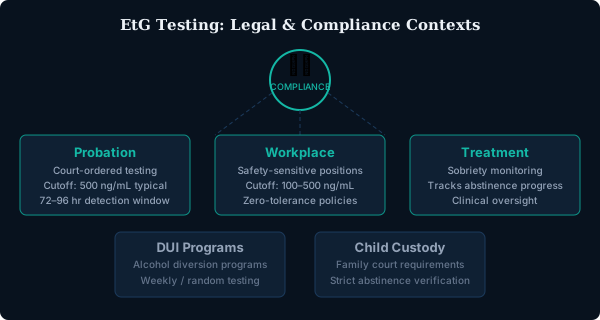
Modern alcohol monitoring programs rarely rely on a single test. Drug courts, probation programs, and DUI diversion schemes use combinations of tools - each designed to catch what the others miss. Understanding how they fit together helps you know what you're subject to and what each tool can and can't detect.
The Problem Each Tool Solves
No single monitoring method provides complete coverage. Here's the gap each technology addresses:
Breathalyzers detect current intoxication - but only while alcohol is still in the bloodstream (roughly 1-12 hours after drinking, depending on amount consumed). They're real-time but have a short window and require face-to-face administration.
Urine EtG testing extends the detection window to 24-80 hours, catching drinking events that a breathalyzer would miss. But it requires specimen collection and lab analysis - there's a time lag between drinking, testing, and getting results.
SCRAM bracelets detect transdermal alcohol continuously (sampling every 30 minutes). They cover the real-time gap between scheduled tests. But they only detect current or very recent drinking, not events from 2 days ago.
Ignition interlocks require a breath sample before starting the vehicle and at random intervals while driving. They prevent drunk driving but don't track drinking in general.
Used together, these tools create overlapping coverage that closes most gaps in monitoring.
How EtG Fits Into Drug Court Programs
Drug court programs, which divert substance-use-related criminal defendants from incarceration into treatment and supervision, are among the most intensive users of EtG testing.
Standard drug court alcohol monitoring typically involves:
The combination of breathalyzer (catches current) and EtG (catches past 72 hours) at 2-3 test intervals per week creates coverage that leaves very limited unsupervised windows.
To understand how much time must pass between drinking and a 100 ng/mL EtG test to likely result in a negative, our EtG calculator models this specifically - enter your drink count, body weight, and select 100 ng/mL as the cutoff.
SCRAM Monitoring: How It Works
SCRAM (Secure Continuous Remote Alcohol Monitor) is an ankle bracelet that samples skin vapor every 30 minutes and transmits data to a monitoring service. Because alcohol evaporates through skin alongside sweat, transdermal alcohol concentration (TAC) correlates with blood alcohol content - with approximately a 1-2 hour lag.
What SCRAM detects:
What SCRAM doesn't detect:
SCRAM + EtG combination: Some programs use both. SCRAM provides real-time continuous monitoring (catches anyone who drinks and then tests positive on transdermal); EtG urine tests fill the 24-72 hour retrospective window where SCRAM data may already show zero even though the person drank. The combination leaves very little room.
Ignition Interlock Requirements
Ignition interlock devices (IIDs) require a clean breath sample before vehicle startup, with rolling re-tests during driving. These are DUI-specific - they don't function as general alcohol monitoring outside the vehicle.
IIDs typically use a 0.02% BAC threshold (below the legal limit) to prevent driving after any drinking. Programs that include IIDs alongside EtG testing are catching two different behaviors: drunk driving specifically (IID) and alcohol use generally (EtG).
For people in IID-mandated programs: the device doesn't interact with EtG testing. They measure different things through different mechanisms. Being IID-compliant (no attempt to drive after drinking) doesn't affect your EtG test result.
Alcohol Treatment and Recovery Monitoring
Residential and outpatient alcohol treatment programs use EtG to verify sobriety compliance between sessions. Monitoring frequency depends on program intensity - intensive outpatient programs may test weekly or bi-weekly; residential programs may test on re-entry after passes or visits.
In recovery contexts, the 100 ng/mL cutoff is standard. The goal isn't just detecting obvious heavy drinking - it's detecting any alcohol use, including the "just a few drinks, it's not a big deal" relapse that a 500 ng/mL test might miss.
For people in recovery monitoring, understanding the detection window for small amounts of drinking matters: 1-2 drinks at 100 ng/mL can remain detectable for 30-46 hours. A Friday evening drink can still show on a Sunday test.
What Happens When Monitoring Catches a Violation
Each program has its own protocol, but the general pattern:
A 110 ng/mL result from someone who claims mouthwash exposure is handled very differently from a 3,500 ng/mL result. Programs with strong MRO (Medical Review Officer) involvement handle incidental exposure claims more rigorously, reducing wrongful consequences.
Calculating Your Window in a Monitored Program
If you're in a program that includes EtG testing and you want to understand what your specific detection window looks like, our EtG urine test calculator gives you a personalized estimate based on drinks consumed, body weight, and cutoff level.
For the full breakdown of detection windows by drink count, see how long EtG stays in urine. For specifics on how probation and court programs use EtG testing, see our guide on EtG testing in probation and court monitoring.