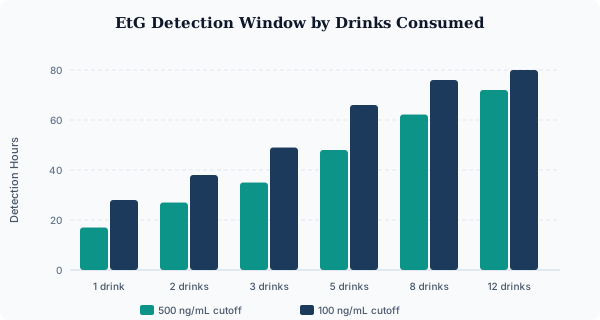
The single biggest factor in how long EtG stays detectable in your urine is how much you drank. Not your weight, not your hydration - the drink count. This article breaks down exactly how light, moderate, and heavy drinking each produces different detection windows, with real numbers.
The Baseline: What Is a Standard Drink?
Before the numbers mean anything, the unit of measurement has to be right. A standard drink contains 14 grams of pure alcohol. That's:
A 16 oz craft beer at 7% ABV counts as about 1.9 standard drinks. A glass of wine poured generously to 7 oz is closer to 1.7 drinks. High-ABV cocktails can easily pack 2-3 standard drinks.
Miscounting is the main reason people's actual test results don't match their estimates. If you had four craft IPAs, you may have consumed the equivalent of 6-8 standard drinks.
Light Drinking (1-2 Standard Drinks)
At the 500 ng/mL standard cutoff, 1-2 drinks typically clear within:
At the 100 ng/mL strict cutoff:
For most social drinkers who had one drink with dinner, a 500 ng/mL test the next morning is very likely to come back negative. At 100 ng/mL, a drink at 8 PM might still read positive the next day if tested before noon.
Moderate Drinking (3-5 Standard Drinks)
This is the range that catches most people off guard. Three to five drinks - a normal dinner out, a few beers watching the game - puts you in a range where detection extends well into the next day.
At 500 ng/mL:
At 100 ng/mL:
Four drinks at a Friday dinner can still be detectable at a 100 ng/mL test on Sunday evening. This surprises a lot of people who assumed "a few drinks" would clear by the next morning.
Heavy Drinking (6-10 Standard Drinks)
Heavy drinking produces peak EtG concentrations that are high enough to remain above detection thresholds for two to three days.
At 500 ng/mL:
At 100 ng/mL:
The 80-hour figure that gets cited so often corresponds to this range - 8-10+ drinks at 100 ng/mL. For most people in most scenarios, 80 hours is the outer bound, not the typical result.
Very Heavy Drinking (10+ Drinks)
Above 10 standard drinks, the detection window approaches the physiological ceiling of approximately 80 hours at 100 ng/mL. The incremental increase slows because the elimination rate doesn't change - more drinks means a higher starting peak, but EtG clears at the same rate regardless.
Think of it this way: going from 5 drinks to 10 drinks roughly doubles the peak EtG. Going from 10 drinks to 20 drinks doubles it again. But each time, EtG has to clear the same fraction per half-life. More drinks doesn't linearly extend detection beyond the ceiling - it just means you hit the ceiling more reliably.
At these levels, essentially anyone will still be detectable at 100 ng/mL 48 hours after stopping drinking. Most will be detectable at 72 hours. Some at 80 hours.
Why the Same Drink Count Gives Different Results
Two people who both had 5 drinks can have EtG detection windows that differ by 12-20 hours. The main reasons:
Body weight: A 250 lb person has more blood volume than a 130 lb person. The same amount of alcohol produces a lower EtG concentration per unit of blood, and a lower peak EtG means less time above the detection threshold. Our EtG calculator accounts for this in its model.
Drinking speed: 5 drinks in 2 hours produces a higher EtG spike than 5 drinks in 6 hours. Faster consumption compresses the absorption window, driving peak concentration higher.
Hydration: Drinking water doesn't eliminate EtG faster, but it dilutes urine concentration. A well-hydrated person's urine may drop below the threshold slightly earlier than a dehydrated person's, because each milliliter contains less EtG.
Individual variation: After accounting for everything above, there's still genuine person-to-person variation in glucuronidation enzyme activity that shifts results by 20-40%. This is the variable no calculator can fully capture.
Worked Example With the Calculator
Take a 165 lb person who had 6 drinks over 3 hours, using 500 ng/mL cutoff:
Wait - that seems short. This is a 500 ng/mL cutoff example. Change it to 100 ng/mL: that peak EtG needs to fall to 100 ng/mL instead. That's nearly 4 half-lives of elimination = 12 hours, plus 1.5 to peak = roughly 14-16 hours from last drink at minimum, with variation potentially pushing to 20+ hours.
Run your specific numbers through our EtG detection time calculator - it handles all of this math for your weight, drink count, and drinking duration.
Summary Table
| Drinks | 500 ng/mL Window | 100 ng/mL Window |
|---|---|---|
| 1 drink | 12-22 hrs | 20-36 hrs |
| 2 drinks | 20-34 hrs | 30-46 hrs |
| 3 drinks | 28-42 hrs | 40-58 hrs |
| 5 drinks | 40-56 hrs | 58-74 hrs |
| 8 drinks | 54-70 hrs | 72-80+ hrs |
| 10+ drinks | 60-80 hrs | 76-80+ hrs |
For a full guide to the factors that shift these numbers, see our article on what affects EtG detection time. For the detailed EtG timeline at all drinking levels, see how long EtG stays in urine.